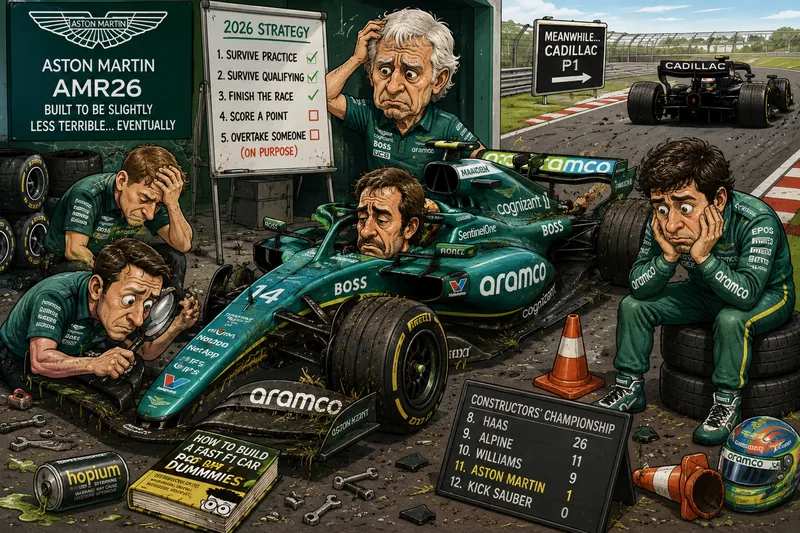
The team entered 2026 with enormous expectations. Newey was brought in to design the car, Honda returned as works partner and Aston Martin's shiny new AMR26 was supposed to launch the team into championship contention.
Instead, it launched itself approximately towards the back of the grid.
Early testing was blighted by power-unit vibrations, reliability problems and an alarming shortage of actual laps. Lance Stroll estimated that the car was around four-and-a-half seconds off the pace, a figure that prompted Aston Martin engineers to briefly check whether they had accidentally entered a Formula 3 car.
The first three races produced four retirements between the drivers, while the team struggled to gather enough useful data to determine whether the problem was the engine, chassis, tyres, aerodynamics or possibly the entire concept of Formula 1.
By May, Aston Martin had at least managed the remarkable achievement of getting both cars to the finish at Miami. Neither scored a point.
This was described internally as “progress”.
In June, the situation became even more impressive. Rather than continually bolting bits onto a fundamentally troubled car, Newey decided to concentrate on one enormous upgrade package later in the season.
This meant Aston Martin would spend several months deliberately racing a car that was rubbish, in the hope that it would eventually become less rubbish.
Advertisement
It was an extraordinarily British approach to motorsport.
By the end of June, Alonso had managed one point from Monaco. Stroll had none. At the Austrian Grand Prix, the pair finished 18th and 19th, followed by 18th and 19th again at Silverstone.
At this point Aston Martin's biggest championship rival was no longer another team.
It was gravity.
The Belgian Grand Prix in July provided another low point, with Alonso finishing 19th and Stroll retiring. Aston Martin was effectively racing at the back of the field while Cadillac, a brand-new team, wandered around ahead of them looking increasingly uncomfortable about it.
Then came Hungary and the long-awaited upgrade package.
For approximately 17 minutes, Aston Martin appeared to have built a proper racing car.
Alonso briefly ran inside the top ten during practice. Stroll subsequently demonstrated his enthusiasm for the new machinery by suffering a rear-suspension failure and spinning off.
The upgraded cars eventually finished 13th and 14th, having started 20th and 16th. No points were scored, but both drivers spent significant portions of the race actually fighting other cars rather than investigating interesting things at the back of the circuit.
Aston Martin therefore enters the summer break with one championship point, a substantially revised car and renewed optimism.
The team's next objective is reportedly to finish a race in the top ten.
After that, they will attempt something even more ambitious.
Overtake someone.
Preferably on purpose.